
The launch demo
At Snapdragon Summit 2026, Qualcomm introduced Adreno Neural Fusion, its neural upscaler and frame generation for the Snapdragon 8 Elite Extreme Gen 6. The measurement it chose to show the press was an Evolve test. On a Qualcomm reference device, reporters switched between native rendering and Neural Fusion and read the frame rate and SoC power off the benchmark themselves.
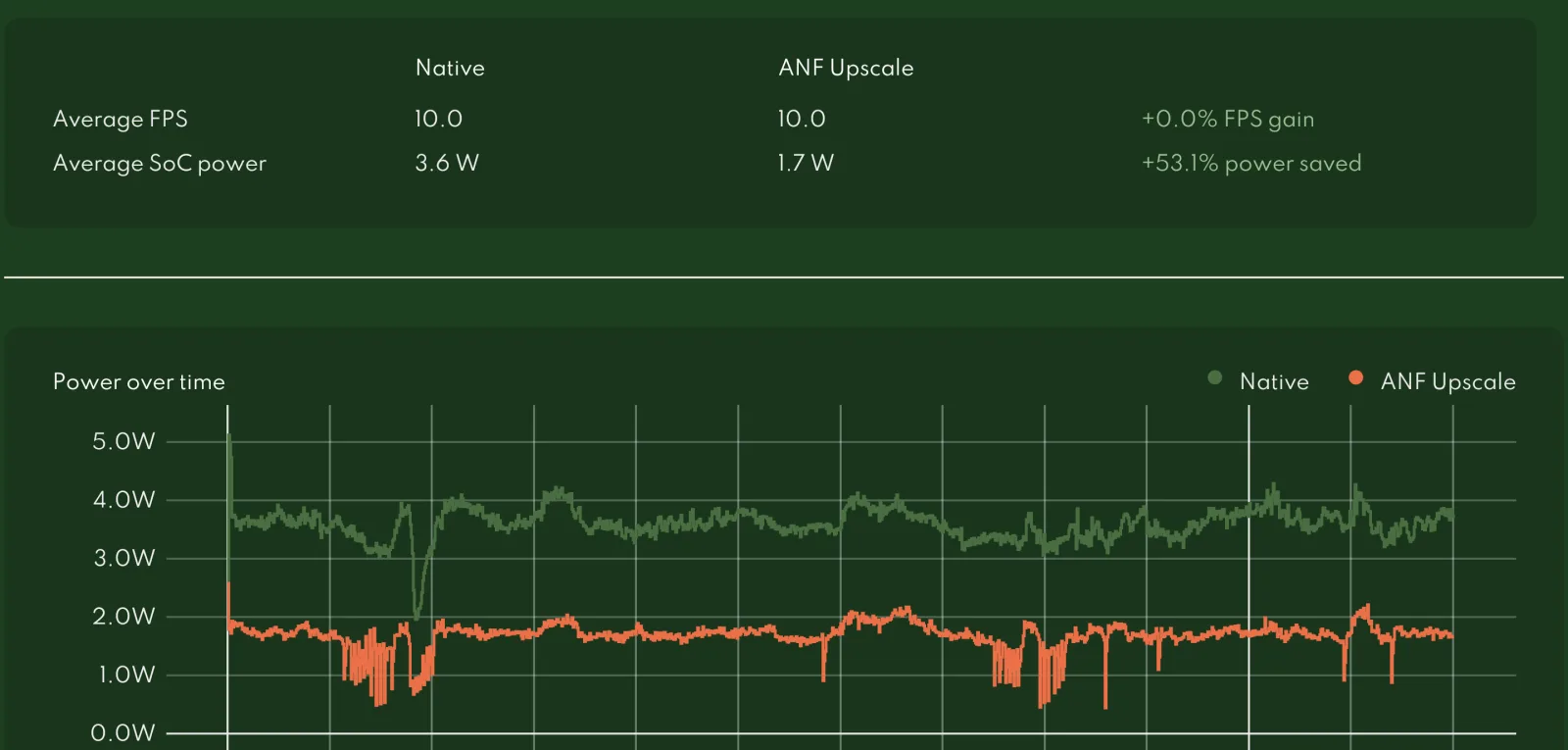
Qualcomm's own figures put the upscaling test at 17.8 fps natively and 52.2 fps with upscaling and frame generation, a 193% increase. The power test locks the frame rate at 10 fps and compares native 1080p with super resolution: 5.6 W fell to 1.0 W, an 81% saving. The reporters' own runs landed close by, at 17.7 to 49.2 fps and 6.2 W to 1.1 W depending on the outlet.

What Evolve brought to it
A launch demo has to hold up in a room full of journalists with their own stopwatches. Evolve's upscaling tests were built for exactly that: three separate tests, upscaling for performance, upscaling for power saving, and upscaling with frame generation, each repeatable and each reporting the measurement conditions alongside the result. The power test is the one a vendor cannot fake, because a fixed frame rate turns the question from "how fast" into "how much energy for the same frames".
The same neural workloads, run inside a renderer rather than as a standalone inference demo, are what we model for vendors before silicon exists. GPU pre-silicon validation · Neural reconstruction and upscaling.
Coverage
- DigitalToday ran the hands-on: 17.7 fps to 49.2 fps, and 1.1 W at a fixed frame rate.
- Notebookcheck reported Qualcomm's figures: 17.8 fps to 52.2 fps, and 5.6 W to 1.0 W.
- The Elec covered the same session and named the app as Evolve Professional: a 178% frame-rate increase and 6.2 W to 1.1 W. tbreak, Archyde, Newsy Today and Memesita picked up The Elec's story.
- Lowyat.NET ran its own session: about 15 fps native, about 45 fps with the upscaler, and the low 60s with frame generation added. GSMGOTech relayed Qualcomm's figures.
- Korean coverage was the heaviest. DigitalToday published the original hands-on, The Elec, Economic Review, TechM and Digital Daily reported the Evolve numbers, and Economic Review's Q&A with Qualcomm's GPU and gaming product director describes the fixed-frame-rate power test in the most detail.
- PC Watch in Japan credited the test to the Evolve Benchmark made by Traverse Research and reported 16.4 fps rising to 52.1 fps. DigitalToday's hands-on also ran in Japanese and Vietnamese.
Several outlets described Evolve as a benchmark Qualcomm developed itself. It is ours: Qualcomm runs it in-house and chose it for the launch. How Evolve stays neutral.