


TraverseGamesWork with us
Menu

Traverse Games

Game performance optimisation

Recover CPU, GPU and I/O headroom in your game, with implementation and repeatable measurements in your engine and build pipeline.

01 / Your project and constraints

The build needs headroom. Your team needs answers.

You might be chasing the last few milliseconds before a milestone, investigating a spike that only happens in a busy scene, or bringing a game to hardware with a tighter budget. Meanwhile, your engine team still has a production roadmap to deliver.

We take on a focused performance investigation and the implementation that follows. Bring a representative build, target hardware and the constraint you need to resolve. Together we establish a baseline and agree where the work will have the most value for your project.

Talk through your performance target

02 / CPU optimisation

Shorten the CPU critical path.

Gameplay, animation, physics, visibility and render submission all compete for CPU time. We profile the main thread and worker jobs, then work on the data layout, cache behaviour, allocations and algorithms behind the expensive paths. SIMD vectorisation, intrinsics and ISPC can help with suitable data-parallel workloads, with instruction-set support and fallback paths matched to your target CPUs.

Multithreading also needs the right shape of work. We tune job granularity, dependencies, work distribution and synchronisation, investigating lock contention, false sharing and idle workers. The goal is a shorter frame-critical path and predictable behaviour under load, with correctness and memory use checked alongside the timings.

03 / I/O and network optimisation

Get data to the game without stalling it.

Loading and streaming cross several systems. We trace disk access, decompression, deserialisation and GPU upload together, then address asset layout, request batching, caching, asynchronous I/O and back-pressure. DirectStorage integration and decompression paths can be part of that work on supported targets, with appropriate storage paths for the rest of your platform set.

Network performance belongs in the same investigation. We work on serialisation, payload size, request batching, update frequency and download or streaming behaviour, measuring bandwidth, latency and jitter against the game’s needs. Queueing, retries and CPU-side processing can matter as much as raw disk or network throughput.

04 / GPU work in context

Keep GPU work inside the frame budget.

A long GPU event can be the symptom of a dependency elsewhere in the frame. We follow the cost through CPU submission, queue synchronisation, shader execution, data movement and resource lifetime, using captures from the workload that matters to your game.

The outcome is a change in your codebase. That may mean restructuring passes, reducing memory traffic, changing an acceleration-structure strategy, or moving repeated work into asset preparation and streaming. We keep the investigation small enough to compare and the implementation grounded in your engine’s constraints.

We measure the changed build against the same conditions, including image quality and memory use. Your team can see what improved, what trade-off was made, and which bottleneck now sets the limit.

PIXTraverse / Breda framework
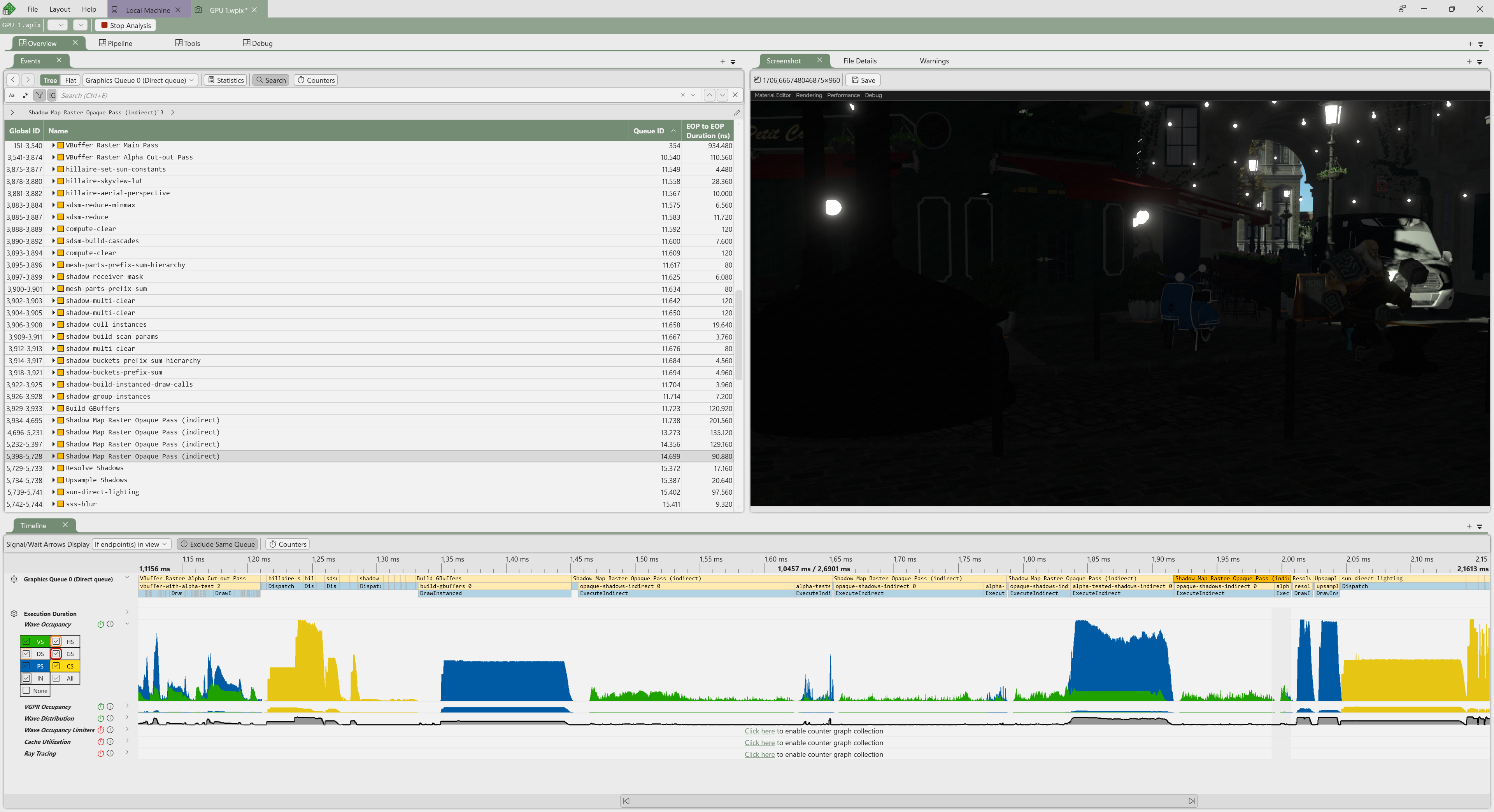
PIX: A Breda rendering capture: frame events, GPU execution and wave occupancy.
A Breda rendering capture: frame events, GPU execution and wave occupancy.

The right tools for your hardware.

Desktop, console and mobile profiling.

  • NsightNVIDIA
  • PIXMicrosoft / DirectX
  • RazorPlayStation
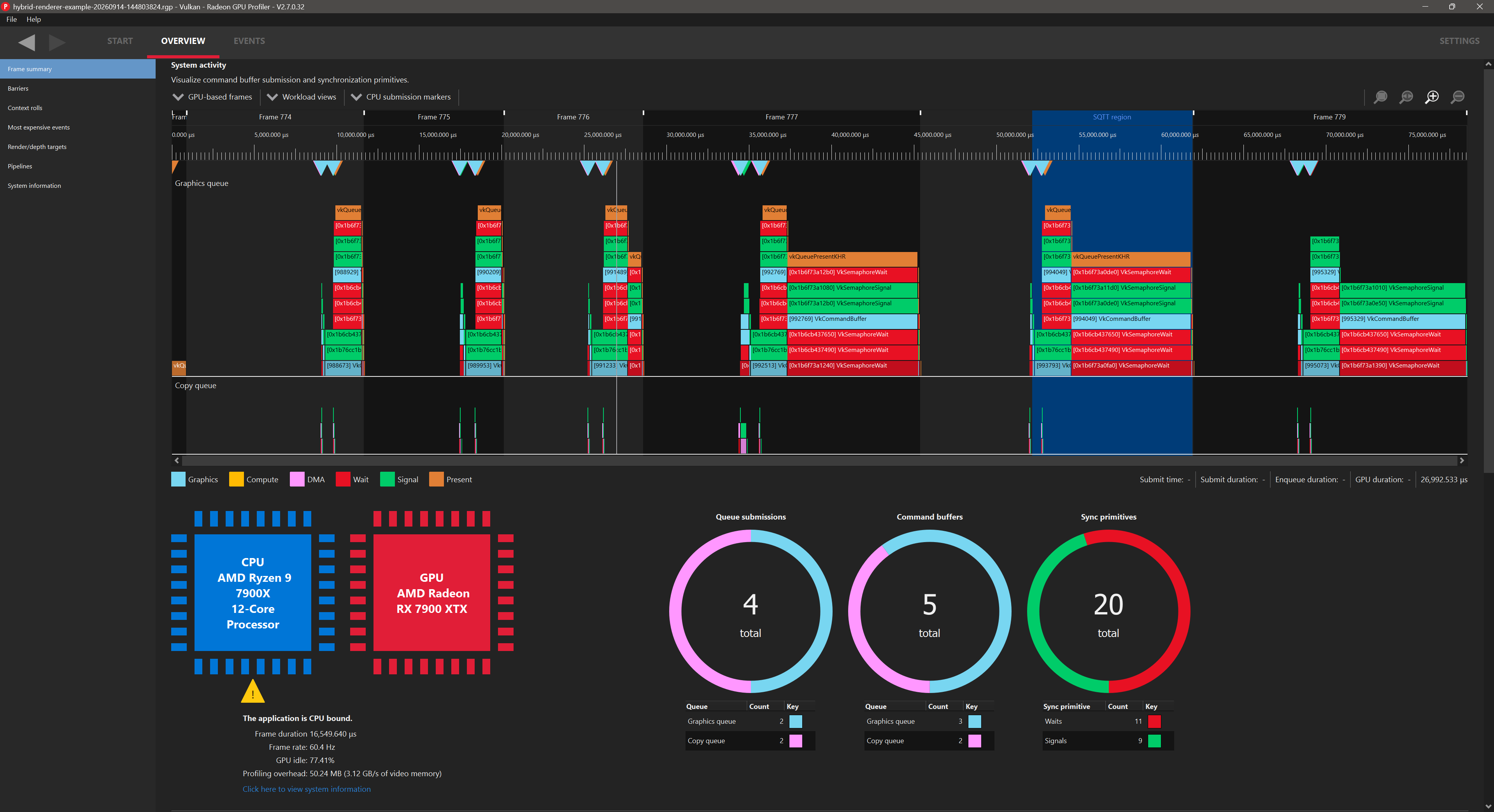
  • AMD RGPRadeon GPU Profiler
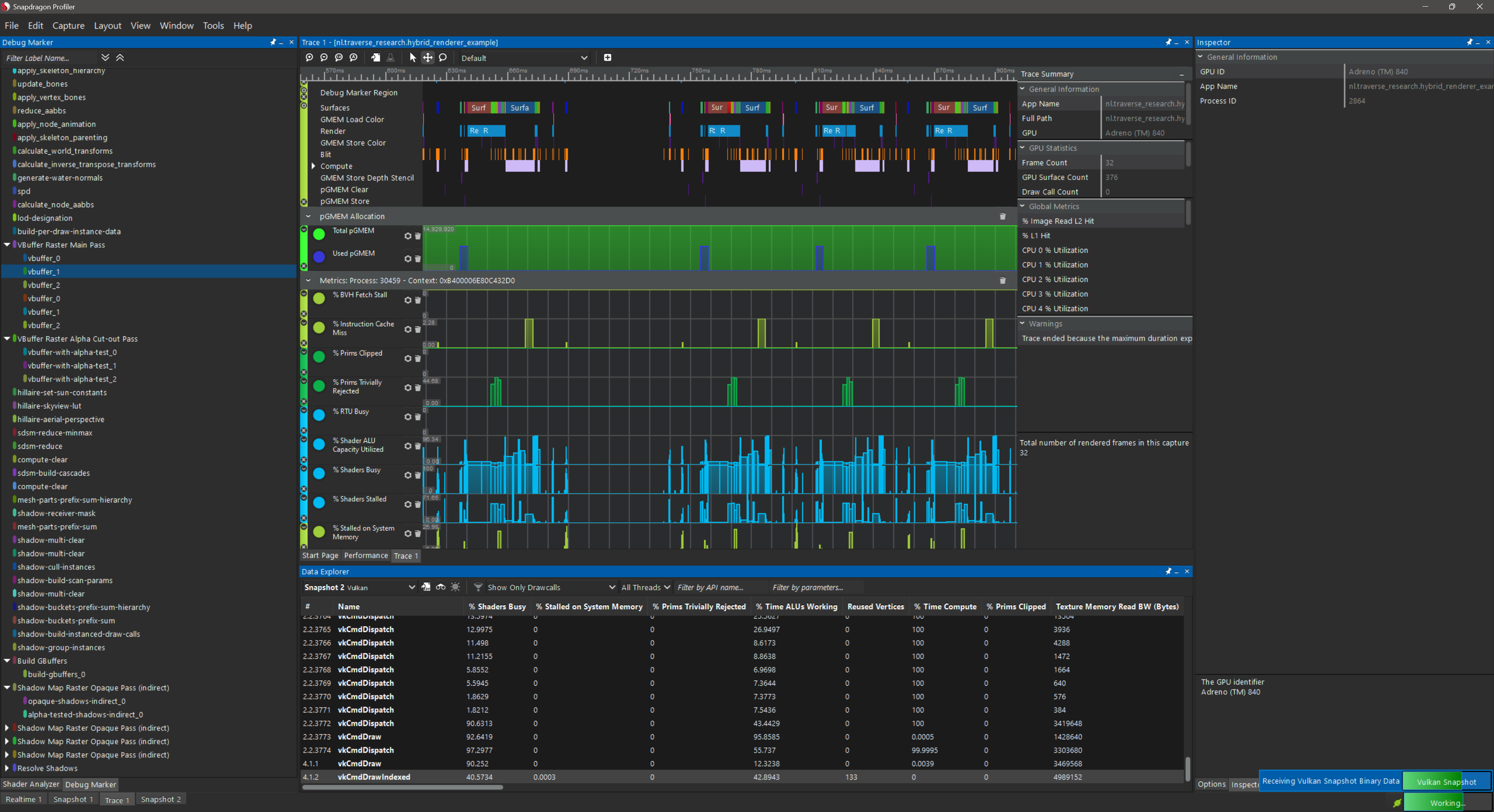
  • Snapdragon ProfilerQualcomm / Adreno
  • SokatoaSamsung profiler
  • Arm Performance StudioArm mobile GPUs
  • SuperluminalCPU performance profiling

05 / Specialists in your pipeline

An extension of your engine team.

Your technical leads work directly with the engineers doing the investigation. We use your source control, build infrastructure and review process, and agree the scope with the people responsible for the game’s performance and visual direction.

Our rendering and GPU research gives us experience below the engine boundary as well as inside it. That helps when a workload behaves differently across vendors or an API feature needs careful integration. The collaborations below show that experience in practice.

How we work with your team

Evolve is our GPU and AI benchmark, and our own product. Qualcomm and Samsung run it in-house. The workload engineering behind it, and our hardware partnerships, inform the investigations we bring to your game.

Explore Evolve

AMD

Acceleration structures under the microscope

Low-level research into BVH construction, traversal and driver-side acceleration-structure behaviour.

Intel

One trillion triangles, path traced

Credited among the contributors to Intel Labs’ Path Tracing a Trillion Triangles.

Explore the collaboration

Qualcomm

Workload analysis on Adreno

Rendering and neural-radiance-cache workloads evaluated on Snapdragon hardware.

A change your team can verify

  • A reproducible baseline for the agreed scenes, hardware and settings.
  • Reviewed implementation changes in your source and build pipeline.
  • Before-and-after measurements for the agreed CPU, GPU, memory, loading, streaming or network targets, with visual comparisons where relevant.
  • A clear account of remaining constraints and recommended next steps.

Your team keeps the implementation and the evidence needed to maintain it after handover.

A few useful answers.

Can you help with a CPU-bound game or slow loading?

Yes. We investigate CPU hot paths and job scheduling as well as disk access, decompression, asset streaming and network processing. The scope follows the measured bottleneck, with platform support guiding choices such as SIMD instruction sets and DirectStorage.

Do you start with a performance target?

Yes. We agree the target hardware, workload, frame-time budget and measurement method before optimisation begins.

Can you investigate an intermittent spike?

Yes. The first task is to make the spike observable and identify the conditions that trigger it.

Will we receive the implementation?

The work is delivered through your agreed source and build pipeline, with direct access to the engineers making the changes.

Traverse Research + Traverse Games

Let’s turn a good question into working software.

Start a conversation