
Measuring hardware that does not exist yet
Traverse Research provides GPU pre-silicon validation and rendering-workload research for hardware partners. We work on architectures years before consumer availability, when there is no device to run a game on and often no silicon at all, only a simulator or an emulation of the design.
That constraint decides the method. A full frame is not a measurement, because it mixes traversal, intersection, shading and memory traffic into one number, and a simulator may run it thousands of times slower than real time. What works instead is a suite of micro-benchmarks: small scenes chosen so that a single property of the workload is the only thing changing.
Geometry chosen to stress the structure
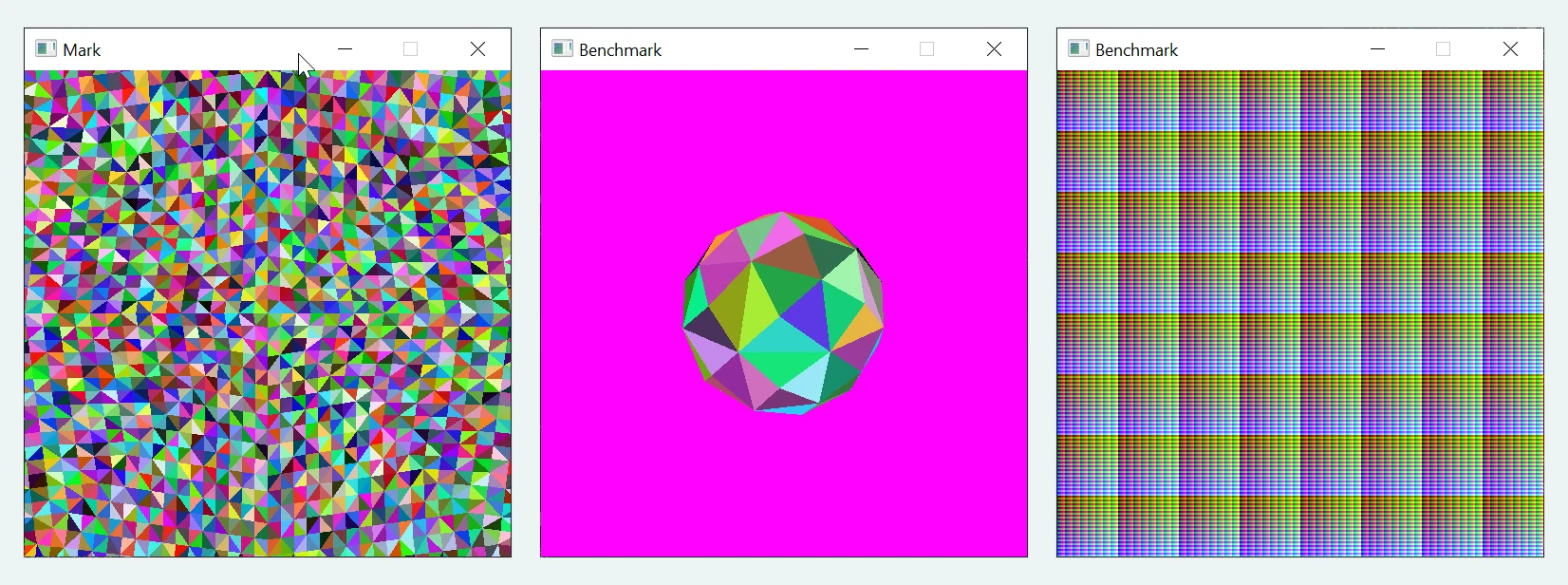
The captures above are three ray-tracing tests from that suite. Each one hands the acceleration structure a deliberately different arrangement of geometry, because how the structure is built and how expensive it is to traverse depend almost entirely on how the geometry is distributed.
Densely packed triangles with no spatial coherence give a structure the hardest case: bounding volumes that overlap heavily, so a ray cannot reject much on the way down and traversal visits far more nodes than the triangle count suggests. A single low-poly mesh on an empty background is the opposite, a compact well-separated hierarchy, which is the baseline everything else is read against. A dense regular lattice is different again, uniform distribution with a great many similar primitives, where a builder that does well on clustered geometry may not.
The magenta is not a background colour so much as a result: it is where rays terminate without hitting anything, so the shape of the miss region is itself part of what the test reports.
None of these is a scene, and none produces a score worth quoting on its own. Their value is that the geometry is chosen rather than inherited, so when a number moves between two revisions of an architecture, the pattern that moved it is already known.
Around the tests sits the harder half of the work: keeping the workload identical across simulator, emulator and first silicon, keeping the measurement conditions recorded alongside the result, and keeping the suite fast enough to run against a design that is still changing.
Built on hardware research since 2019
Traverse began with exactly this work: micro-benchmarking for Imagination Technologies, followed by a pre-silicon ray-tracing benchmark suite for ray-tracing GPUs that had not yet shipped. Read the project account.
That founding engagement grew into rendering research for GPU and mobile hardware vendors, and into the Breda framework and the Evolve benchmark, which carry the same principle: build the workload, understand the rendering path, and keep every measurement attached to the conditions that produced it.
Read about our early hardware work in the Evolve company history. The Rust Foundation’s profile of Traverse explores our work with AMD, Arm, Intel, Samsung and Qualcomm, and our approach to benchmarking throughout development.