Rendering and performance engineering for studios. GPU research for the vendors whose silicon those games will run on. And Evolve, our GPU and AI benchmark, keeping both honest.
The games keep the workloads honest, the research turns them into hardware insight, and Evolve turns that insight into a product. That is why a games studio and a benchmark company share one roof. Studios get that hardware insight, under NDA and on their terms.
For studios and publishers
Games
Rendering and performance engineering for games, and the console porting around it.
Our engineers earned these credits through Traverse’s five-year engagement with Embark Studios. We bring that experience to game porting, platform engineering and co-development.
From Imagination Technologies micro-benchmarks to Embark platform engineering and Samsung’s mobile graphics work. Public projects and publications are linked above.
Years of neural and graphics expertise distilled in a benchmark
Evolve turns our benchmarking research into software you can license and run yourself. Compute, ray tracing, rasterization, drivers, energy, acceleration structures and work graphs, each workload configurable and repeatable.
I left Breda to learn this. I came back to build it.
I grew up in Breda, left for Stockholm to ship Battlefield and Mirror’s Edge at DICE, and came back. In 2019 I founded Traverse here to support GPU teams from early product development and pre-silicon research through every stage of silicon bring-up.
Today we’re 19 people, including 15 engineers, in the same city I started in. We build Evolve, the benchmark Qualcomm and Samsung run in-house, and we’ve done pre-silicon research for most of the hardware vendors on this page. Now we’re bringing that head start back to the studios we came from.
The mission hasn’t changed since day one: make Breda a game development powerhouse.
Learned lighting, built into the renderer. Our mobile neural radiance caching implementation was published with Samsung at SIGGRAPH Asia 2025, connecting rendering research with hardware-aware performance modelling.
Learned texture representations, from training to GPU decoding. We evaluate reconstruction quality, memory footprint and runtime cost alongside conventional texture-compression tools.
A material and rendering capture from Breda, the framework used for our texture research.
Traverse Research
GPU inference
Neural workloads inside the frame. We integrate operators, tensors, inference and training with the render graph, connecting Python model development and ONNX interchange to GPU execution.
Per-material validation loss from a neural-material training run, a panel to a material.
Traverse Research
Neural materials
Learned material appearance, evaluated in a working renderer. NeuBTF, published at SIGGRAPH Asia 2022, explores neural compression and rendering of bidirectional texture functions.
NeuBTF material-representation research, published by Traverse.
Platforms & graphics technology
If it has a GPU, we ship on it.
From console and mobile to desktop and handheld. We work across the platforms you ship on and the graphics APIs behind the frame.
Our engineers earned credits on THE FINALS and ARC Raiders through Traverse’s five-year co-development engagement with Embark Studios.
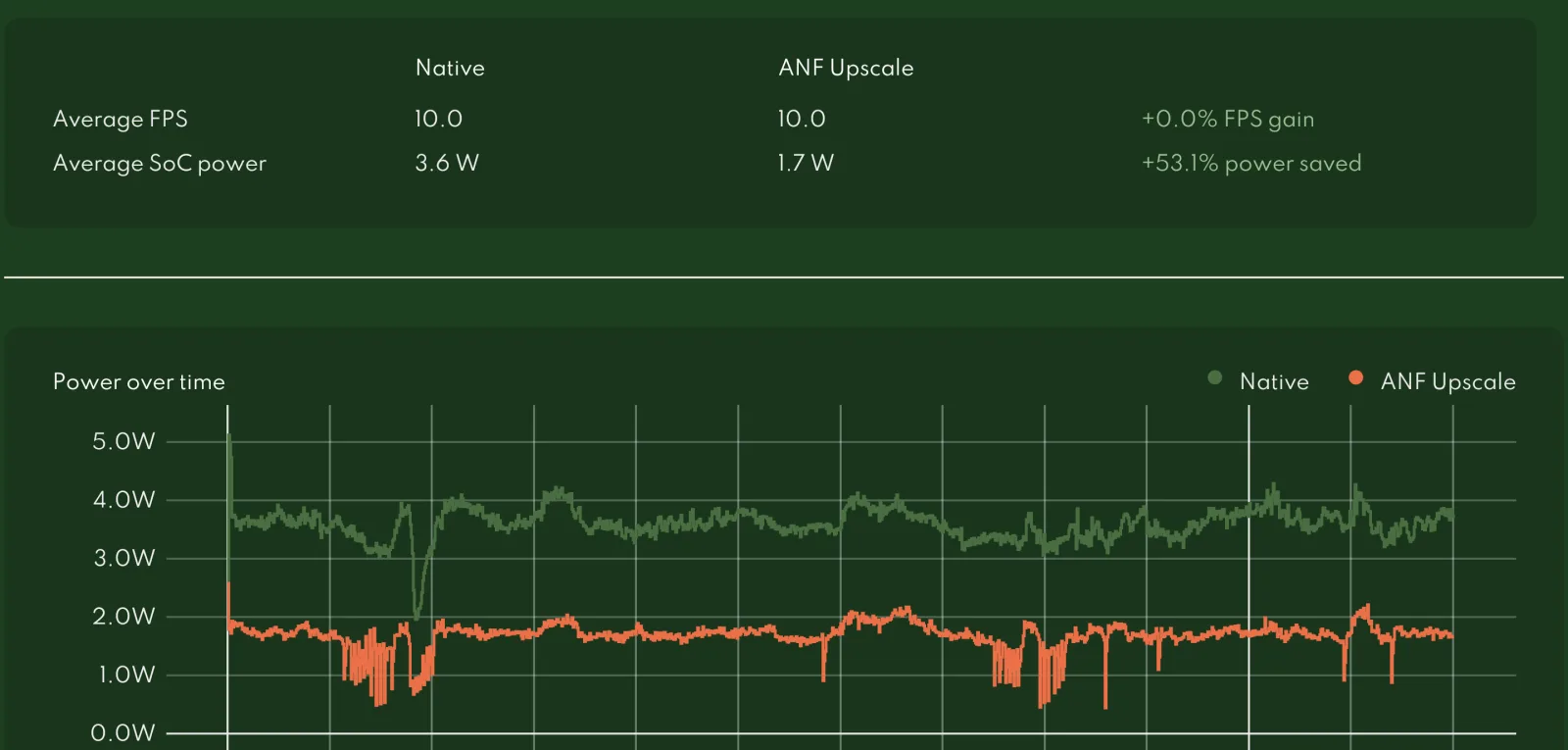
Evolve Professional's power test on the Adreno 850: native against ANF Upscale at a fixed 10 fps. This is our own run on an early unit and driver, 3.6 W to 1.7 W, a 53% saving. Qualcomm's reference device at the summit, and the press on it, measured 5.6 W to 1.0 W, 81%.
Qualcomm launched Adreno Neural Fusion with an Evolve test on the Snapdragon 8 Elite Extreme Gen 6, measuring the upscaler and frame generation in front of the press. Frame rate nearly tripled and power at a fixed frame rate fell from 5.6 W to 1.0 W.
Traverse × Samsung / Mobile ray tracing
A public look at our work with Samsung.
Samsung shared this Xclipse GPU demonstration on its official channel. Built in our Breda rendering framework, it shows our mobile ray-tracing collaboration in action.
BVH construction, refit and driver integration for a desktop GPU vendor, evaluated in shipped game workloads rather than only isolated synthetic tests.
Working with a mobile silicon vendor to investigate rendering performance through Evolve and neural radiance caching on their GPU.
From collaborators and benchmark users.
“I really like the benchmark, the efficiency result is very nice for tweaking the GPU”
“Overall, love the benchmark and the new technologies it uses. Keep it up!”
“I’ve worked with Jasper and his team on four different occasions: Frostbite, SEED, Embark and GPC. I’d hire them again.”
“Traverse Research were a pleasure to work with. The custom Vulkan hardware ray tracing solution they built into our Linux-optimized Unreal Engine branch is still in use years later”
“Traverse Research has been a valued partner to us for over three years; deeply technical, consistently responsive, and genuinely invested in solving the hard problems alongside our team”
MakeReviewRepeat
Good work starts with a shared build.
An initial 16-week commitment, including ramp-up. Four-week sprints, build reviews every two weeks, and direct access to the engineers in your pipeline.
Linear blend skinning is the standard way to deform a character mesh with a skeleton: every vertex stores up to four bone indices and four weights, and its animated position is the weighted sum of where each of those…
In graphics and machine learning conversations, a tensor is a block of numbers with a shape: a list of sizes, one per axis, that tells you how many indices you need to find a single value and how far each index can go.…