



TraverseGamesWork with us
Menu

Traverse Games

Mobile game optimisation

Optimise CPU, GPU and I/O work on Android and iOS, from SIMD and frame pacing to asset streaming, network performance and sustained power.

01 / Your project and constraints

Your game has to work on the devices you ship.

A scene can run comfortably on your development handset and struggle on a midrange device. A busy main thread, a streaming stall or expensive GPU work can each set the limit. Another device may start well, then lose frame rate as it warms. Memory and bandwidth constraints change the choices available to your team.

We help your team work through those constraints on Android devices, iPhones and iPads. Start with the device range, representative scenes and visual target. We identify the limiting work, agree the trade-offs, and implement the changes in your engine branch.

Discuss your game and target devices

02 / CPU optimisation

Make the CPU work fit the device.

We investigate gameplay, animation, physics and render submission alongside allocations and cache behaviour. Data layout and algorithm changes can reduce the work first; SIMD through Arm NEON, vectorised kernels and ISPC where the target toolchain supports it can improve suitable data-parallel paths. We measure the result on the target devices.

Multithreading has to account for the device’s performance and efficiency cores, the operating system’s scheduler and its power budget. We tune job sizes, dependencies, lock contention and waiting behaviour, and keep background work from competing with the frame. CPU time, responsiveness and sustained energy use all matter.

03 / I/O and network optimisation

Keep storage and network work off the critical path.

We trace asset reads, decompression, deserialisation and uploads as a connected pipeline. Asynchronous disk I/O, request batching, asset packaging, caching and bounded background jobs help control startup time and streaming hitches without letting memory use grow unchecked. The implementation uses the storage facilities available on Android and iOS.

Mobile network conditions change during a session. We investigate payloads, serialisation, update frequency, caching and download scheduling against bandwidth, latency and connection loss. Retries, reconnection and resumable downloads need to fit the game’s state and power constraints as well as its data-delivery budget.

04 / GPU work in context

Keep the frame stable as the device warms.

We agree a session length and test conditions that expose sustained behaviour, recording temperature and operating clocks alongside the workload. That gives us a useful baseline for the devices your players will use.

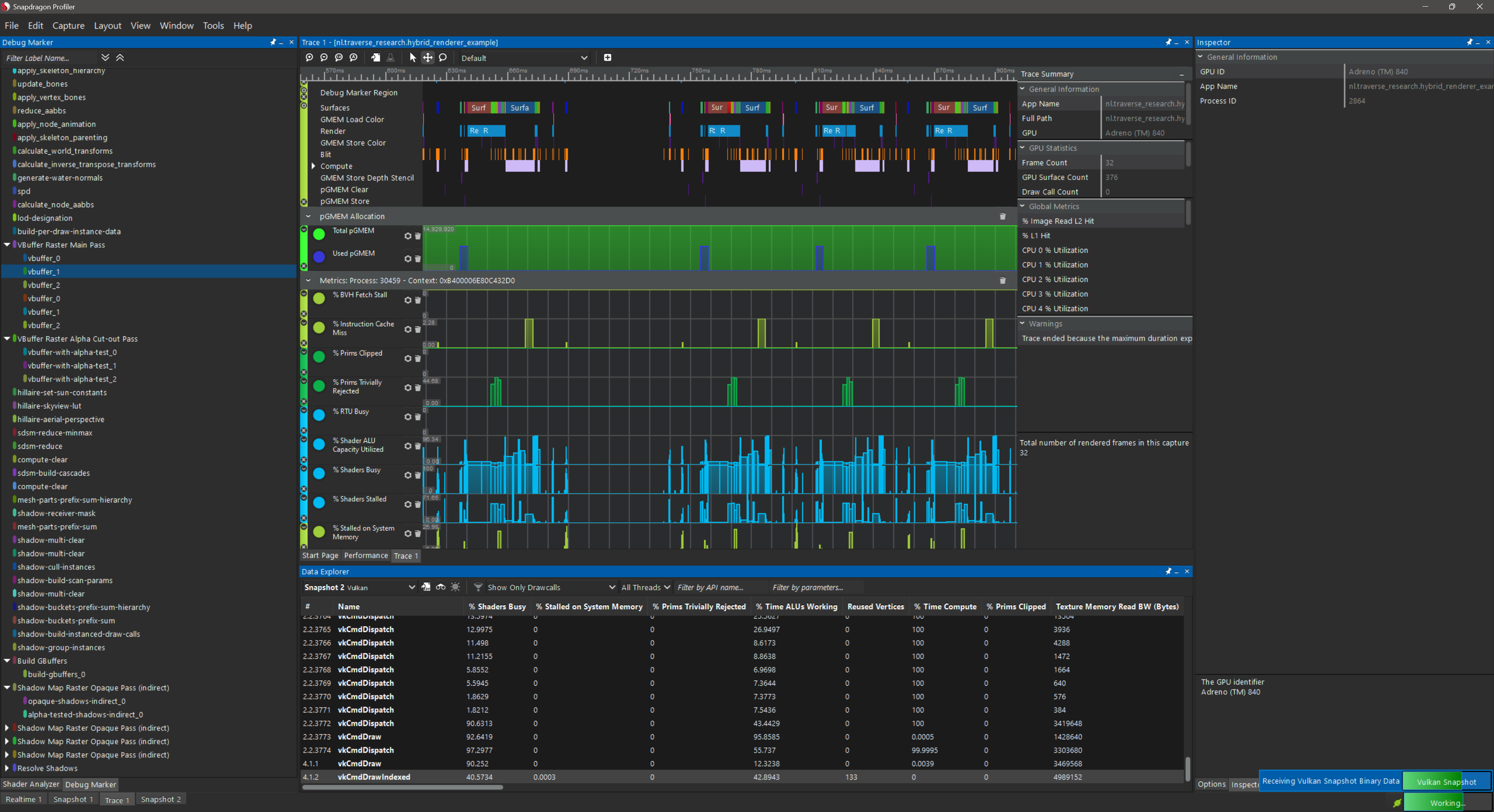
Captures connect rendering markers to bandwidth, local memory, shader stalls and CPU/GPU scheduling. On Android, we use Snapdragon Profiler, Sokatoa and Arm Performance Studio on their respective platforms. For iOS, Xcode’s Metal frame capture and Instruments help us inspect GPU work, CPU activity and memory use on the target iPhone or iPad.

The fix may involve attachment lifetime, material evaluation, pass structure, transfers or asset preparation. We compare the result across the target devices and check frame time, memory, power and image quality together, so a gain on one GPU does not hide a regression on another.

Snapdragon ProfilerTraverse / Breda framework
Snapdragon Profiler: An Adreno workload in Breda: rendering markers, memory use and hardware counters in one capture.
An Adreno workload in Breda: rendering markers, memory use and hardware counters in one capture.

Tools for the mobile investigation.

Android and iOS, profiled on target devices.

  • XcodeiOS / Metal & Instruments
  • Snapdragon ProfilerQualcomm / Adreno
  • SokatoaSamsung profiler
  • Arm Performance StudioArm mobile GPUs

05 / Specialists in your pipeline

Mobile specialists, working inside your team’s pipeline.

Your engine and rendering leads speak directly to the engineers making the changes. We work in your codebase and follow your build and review process. Priorities stay tied to the game’s production schedule and the visual decisions your team owns.

Work with Qualcomm, Samsung and Arm has given us practical experience with mobile workloads, ray tracing and neural-graphics integration. We use that knowledge to ask better questions about your captures and make implementation decisions your team can review.

How we work with your team

Evolve is our GPU and AI benchmark, and our own product. Qualcomm and Samsung run it in-house. The workload engineering behind it, and our hardware partnerships, inform the investigations we bring to your game.

Explore Evolve

Bring us a build and the devices that matter

We agree the Android and iOS requirements, including Vulkan and Metal backends, during scoping. The engagement gives your team:

  • A repeatable baseline across the agreed device set and test sessions.
  • Focused changes delivered through your engine branch and build pipeline.
  • Comparisons covering the agreed CPU, GPU, memory, loading, streaming and network targets, including sustained behaviour and visual quality where relevant.
  • The capture conditions, remaining constraints and next steps needed for handover.

A few useful answers.

Can you investigate CPU, loading and network bottlenecks too?

Yes. We work on CPU algorithms, data layout, SIMD and job scheduling, plus the storage, decompression and network paths feeding the game. We test the changes under the agreed device, session and connectivity conditions.

Do you measure sustained performance?

Sustained performance is part of the agreed test plan, including device conditions and representative workloads rather than only short captures.

Can we preserve our visual direction?

The visual target and acceptable trade-offs are agreed with your team before changes are made.

Can you help with mobile ray tracing?

Yes. Traverse’s published work includes a ray-tracing demo for the Samsung Galaxy S24 and rendering research with mobile hardware vendors.

Traverse Research + Traverse Games

Let’s turn a good question into working software.

Start a conversation